WHAT UNIFIED REVENUE OPERATIONS ACTUALLY LOOKS LIKE
For many manufacturing leaders, Revenue Operations has become another business buzzword. But the real issue is not whether teams understand the term.
It’s whether Sales, Marketing, and Customer Service are designed to operate as one connected revenue system. When your sales cycle is long and technically complex, slowing growth can look like a people problem. More often, the people are doing their jobs inside a revenue system that was never designed to work as one.
Unified Revenue Operations is not about adding another platform or dashboard. It’s about intentionally designing the people, processes, systems, and data behind revenue so every team works from shared information and follows a connected workflow.
What Alignment Looks Like In Practice
So, what does Unified Revenue Operations actually look like on a Monday morning?
It looks like this:
- Sales and marketing review the same dashboard and agree on what the numbers mean.
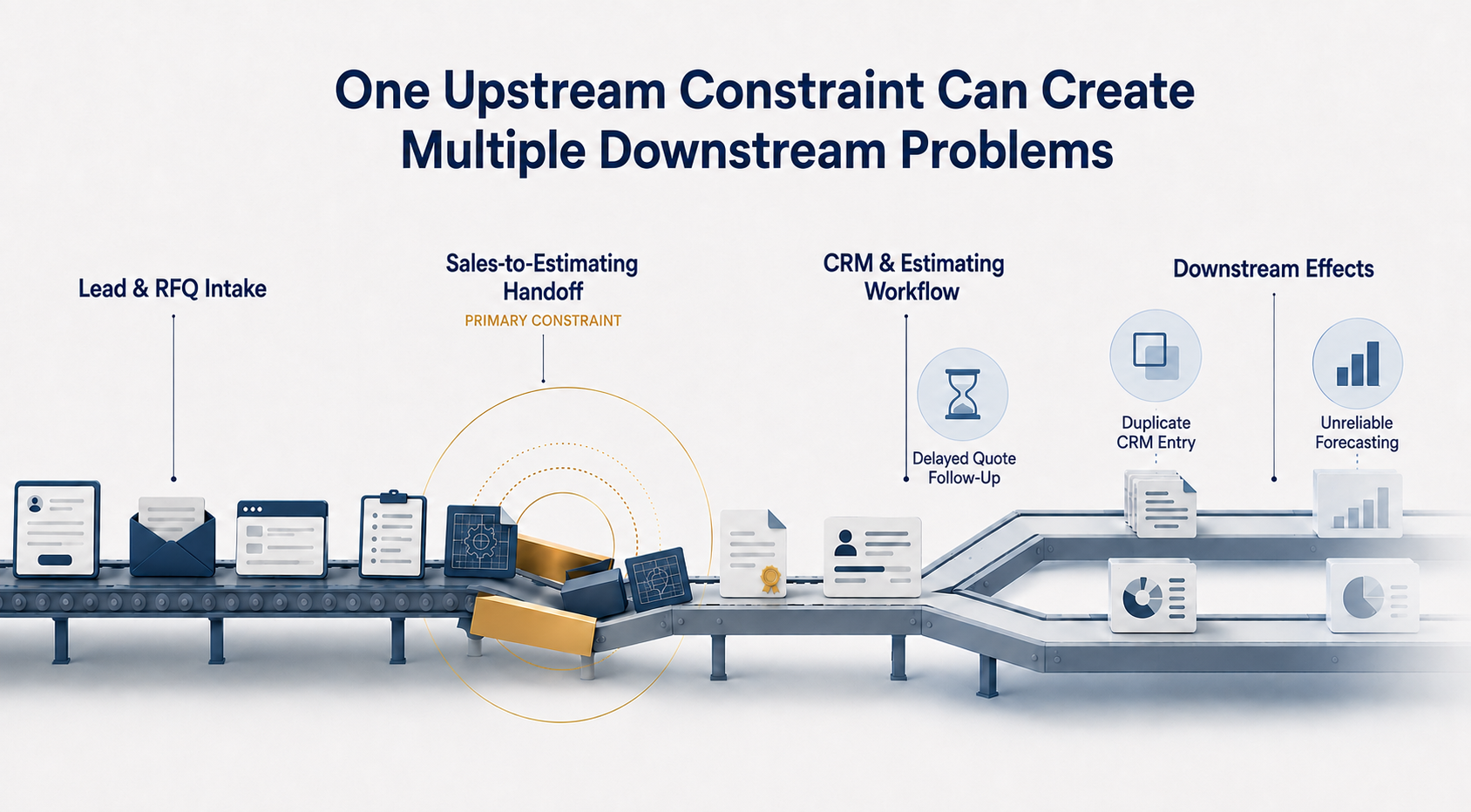
- Leads move through a defined handoff instead of getting lost in email chains asking, “Did you get this?”
- Customer Service sees the entire customer journey before implementation begins, so every conversation starts with context.
- Leadership can answer “Where are we losing revenue?” without waiting days for reports to be reconciled.
Those improvements do not happen because people suddenly work harder.
They happen because the revenue system is designed to make it easier for every team to work together.
Ownership Is The Starting Point
One of the biggest challenges we see isn’t effort. It’s lack of clarity around ownership.
Everyone knows what Marketing does. Everyone knows what Sales does. Customer Service has its role. The confusion happens between teams. Who owns the handoff? Who keeps information from getting lost? Who keeps the revenue system moving?
In a unified revenue system, those answers are clear.
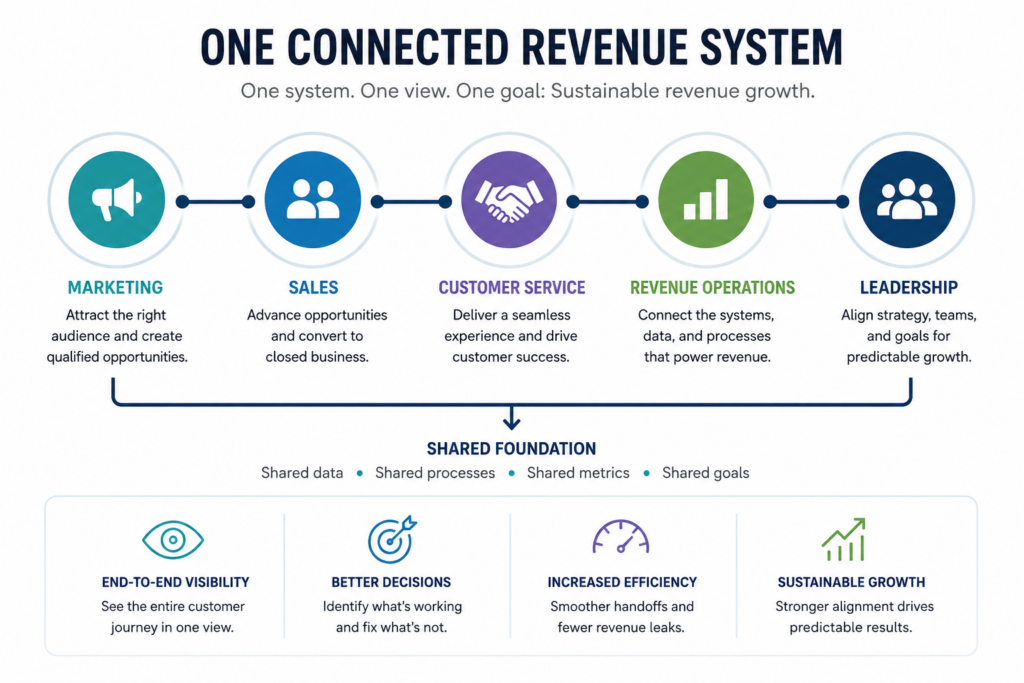
Marketing creates qualified opportunities and prepares them for a successful handoff.
Sales advances opportunities and connects closed business to a smooth customer transition.
Customer Service strengthens onboarding, retention, and customer insight.
Revenue Operations connects the workflows, systems, reporting, and data behind revenue.
Leadership aligns the entire system around shared goals, priorities, and accountability.
When ownership is clear, work moves faster. Handoffs become smoother. Customers have a better experience. The goal isn’t to make every department operate the same way. It’s to design the connections between them so revenue can move without unnecessary friction.
Shared Reporting Creates Clarity
The clearest sign of a connected revenue system? Nobody asks, “Whose number is this?”
In disconnected organizations:
- Marketing reports on leads.
- Sales reports on deals closed.
- Nobody owns what happens in between.
One connected revenue system changes that.
Instead of separate definitions, disconnected reporting, and informal handoffs, every team works from:
- One shared pipeline view
- One definition of a qualified lead
- One clear owner at every stage
- One documented handoff process
This doesn’t mean departments merge into one.
It means the revenue system is designed around one shared view, with clear points where information, responsibility, and accountability pass from one team to the next.
When reporting is aligned, leadership can stop debating whose data is right and start asking better questions:
- Where are deals slowing down?
- Which lead sources consistently create qualified opportunities?
- Where are handoffs breaking down?
- Which activities are actually producing revenue?
That shift makes decision-making faster and more productive.
Shared Metrics Improve Decisions
Every department has its own metrics. Marketing tracks demand. Sales tracks pipeline. Customer Service tracks retention.
The problem isn’t the metrics. The problem is measuring success in isolation.
When everyone is working from different reports, leadership ends up reconciling multiple versions of the truth before they can make a decision. Shared metrics eliminate that guesswork. Unified Revenue Operations shifts the focus from individual departmental performance to the health of the entire revenue system.
Teams still own their metrics, but they also share responsibility for how revenue moves from first contact through customer success. That might include metrics like:
- Lead-to-opportunity conversion: Are qualified leads becoming sales opportunities?
- Pipeline velocity: How efficiently are deals moving?
- Opportunity aging: Which opportunities have stalled?
- Win rate: How often do qualified opportunities become customers?
- Forecast accuracy: Does pipeline reflect actual revenue?
The Leadership Value of a Connected Revenue System
The biggest benefit isn’t better dashboards. It’s better decisions.
Without a connected system, leaders can’t confidently answer:
- Is the forecast reliable?
- Which marketing channels create revenue?
- Where is pipeline slowing?
- Are handoffs breaking down?
A connected revenue system restores trust and confidence.
Confidence that the numbers are accurate.
Confidence that the pipeline reflects reality.
Confidence that problems are identified before they become missed opportunities.
That’s the real value of a connected revenue system.
Start With the Gaps
Before adding another tool or campaign, identify where your current system is breaking down or causing friction.
The 5-Minute Revenue System Gap Finder Self-Assessment helps reveal where handoffs, ownership, workflows, and visibility are breaking down so you can prioritize the changes that will have the greatest impact.