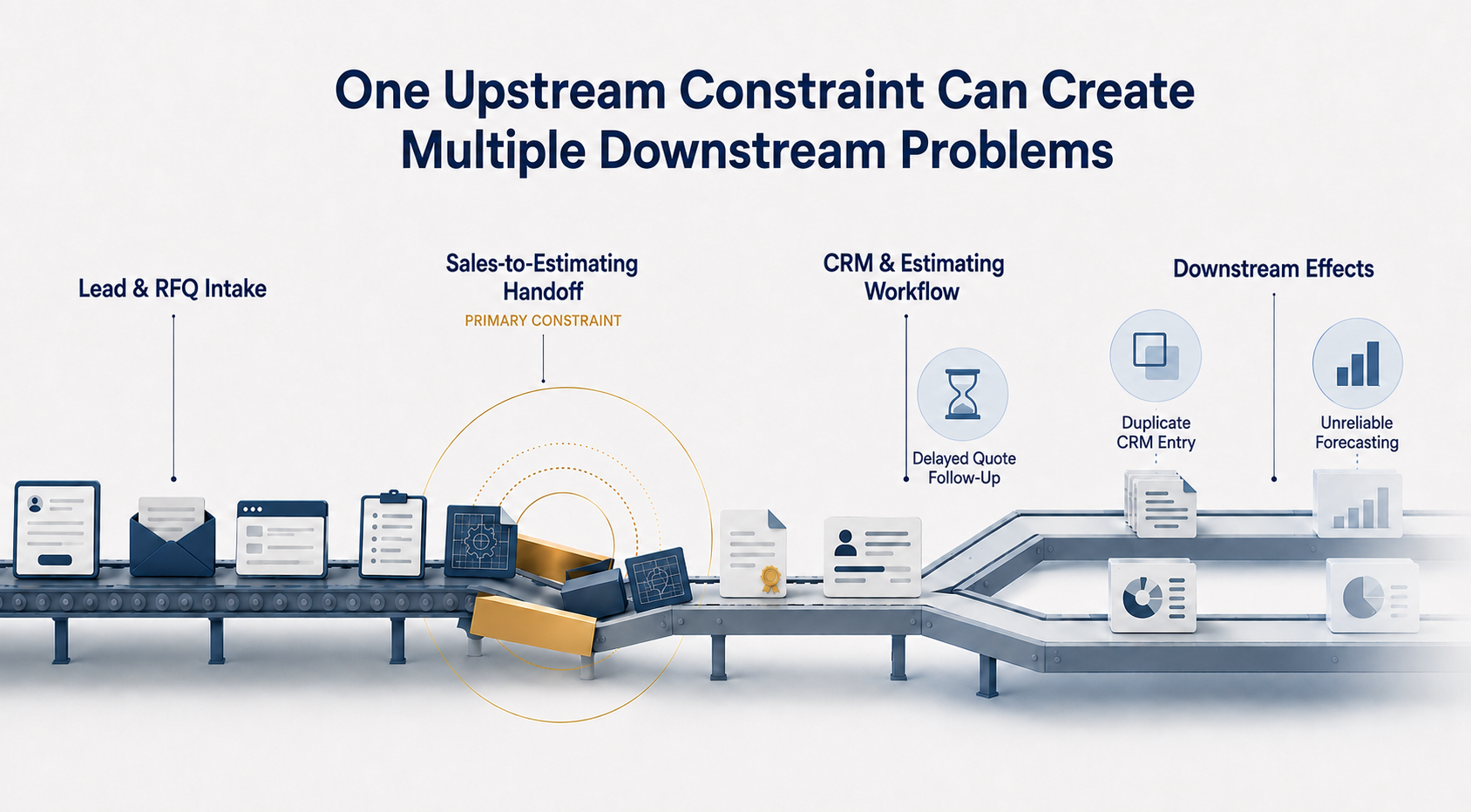
The Value of One Unified System: 60% Fewer Dropped or Stalled Leads
A quote goes out. Everyone moves on to the next request.
Two weeks later, someone asks where it stands. Sales thought estimating was revising the quote. Estimating thought sales was confirming the changes with the customer. The customer hasn’t heard from either.
It’s a hypothetical example, but the gap is familiar: work gets done inside each department, while the opportunity stops moving between them.
In our last article, we explored how a connected manufacturing revenue system works. Here, we look at what changes when fewer opportunities get lost between teams.
Where the Opportunity Stalled
A lead can look active in the CRM while nobody is taking the next step.
Marketing passed it to sales. Sales needs a technical review. Engineering needs a specification. Estimating is waiting on confirmation before building the quote.
Each team has a reasonable explanation. But without a shared owner and a follow-up expectation, waiting quietly becomes the default.
As an engineer-founded consultancy, Acadia looks at the full path to find where the movement breaks down.
At a mid-sized industrial equipment manufacturer, requests stalled between sales and the quoting team because key details were missing. Repeated calls and emails to gather that information delayed quotes by several days, putting the 24-hour quoting target out of reach and frustrating both teams.
What the Diagnosis Revealed
“Why aren’t people following up?” isn’t the most useful question. These are better:
Where does responsibility get unclear? What tells the next person the work is ready? Can anyone see when an expected next step hasn’t happened?
An opportunity marked “qualified” might still be missing what engineering needs. A finished quote might have no assigned follow-up. A handoff might be logged as done before the receiving person has accepted it.
These are different constraints. Finding the real one gives the team a clear place to start.
For this client, the constraint was missing quote details. The quoting team lacked the information needed to move requests forward, preventing it from meeting the 24-hour response KPI.
What Changed in the System
Through Phase 3: Build & Optimize, Acadia works alongside the team to connect stages, ownership, follow-up, and reporting across sales and marketing, with the technical and estimating teams involved along the way.
The aim is practical: each opportunity has a clear next step, someone responsible for it, and a way to see when it needs attention.
Working with sales and the quoting team, Acadia created tasks and daily reminders to keep requests in view. Reports and daily huddles helped the teams review what could move forward and what was still blocked. Requests that were ready advanced; those that could not proceed received a fresh 24-hour window.
That clarity helps the process reinforce consistent follow-through. People can see what they need to do without waiting for a leader to chase every transition.

What the 60% Result Means
For this client, dropped or stalled quote requests fell 60% after the workflow changes were introduced.
Long manufacturing sales cycles include legitimate pauses. A customer may need time to decide, or engineering may need another specification. What matters is whether the reason is visible and someone owns the next step. In this engagement, “dropped or stalled” meant quote requests that could not move forward within the 24-hour target because required details were missing or follow-up had not occurred.
That result shows better follow-through. To understand its financial value, leaders can track how those opportunities progressed, which became orders, and the margin they contributed.
What Leaders Gain
Leaders can see where intervention is needed before an opportunity disappears into the backlog.
Which quote needs follow-up? Which RFQ needs technical input? Who can resolve the hold-up?
With those answers visible, leaders can focus on decisions that need their judgment, and the team can handle routine transitions on their own.
Reports, tasks, and daily huddles gave sales and the quoting team a shared view of the work. Finger-pointing stopped as the conversation shifted to what was missing and what could move forward.
Where Does Your Pipeline Stand?
Where do opportunities wait longer than they should, and who owns getting them moving?
Download the Revenue System Friction Check to spot warning signs in handoffs, ownership, and follow-up that may be keeping your opportunities from advancing.
Already seeing a recurring gap? Schedule a Revenue Systems Diagnostic Conversation to explore what’s causing it and where to focus next.